A couple of years ago, I posted an article about rings as lesbian fashion signals, particularly those worn on the little finger and the thumb. The response to this article by Brazilian lesbians exposed me to a lesbian fashion signal that I hadn’t previously encountered, and that has lingered in my consciousness ever since: the coconut thumb ring. In comments and messages I’ve been told repeatedly that a coconut ring, usually worn on the thumb, is an established symbol of lesbian identity in Brazil. Yet, there’s very little written about it either in English or Portuguese, and its significance within the broader fashion culture of Brazil’s lesbian communities is hard, at first, to establish from an outside perspective.
The majority of the research that I’ve published on Dressing Dykes focuses on lesbian fashion and its history in Europe and North America. Largely, this is because of my own cultural references, and the limitations of only speaking one language. I am writing about Brazilian lesbian fashion, history and symbols today because it is an integral part of a broader history of lesbian fashion as well as a unique expression of it. I must be clear, however, that I am not Brazilian and I have never been to Brazil. My research is not first hand, and this article would not have been possible without the contributions of those who reached out to me to talk about their own experiences as lesbians or queer women in Brazil, and the fashions that shape their communities. A million thank yous to you all.1
The coconut ring is overwhelmingly the most common lesbian fashion signal in Brazil. There are, of course, other styles popular within Brazilian lesbian communities, but the coconut ring is unique because it is a single item and because it is specifically Brazilian. It didn’t grow from lesbian communities out of nothing, though, and has a rich and winding history that led to its myriad uses today. ‘Coconut ring’ is a colloquial term – the ring is made from the shell that encases the seeds of the tucum fruit (which grow on the tucum palm tree or astrocaryum vulgare, a species native to Brazil), which look like small coconuts. Coconut rings are cheap and easy to obtain due to being made from a natural material, and their significance is rooted in this.

Coconut or tucum rings (stock photograph).
The history of the coconut ring has largely been passed down by word of mouth and personal observations, so the specifics are hazy: the rings were made and worn by enslaved people in the 19th century, at once a symbol of resistance and of relationships (romantic and otherwise). In and around the 1960s, its use by marginalised communities, often those living in poverty, led to another meaning – it was embraced by some Brazilian Christians who wanted to show solidarity with those in poverty, as well as to represent friendships that crossed cultural and social boundaries.2 Though the LGBTQ community often has a strained relationship with religion, this is of course not innate. It makes sense to me that queer people and lesbians in particular also found their way to the coconut ring as a symbol, since it represents the marginalisation and resistance that so many LGBTQ people have faced historically, and continue to face today.
The route that lesbians took to their wholehearted embracing of the coconut ring may be unclear, but it certainly happened. In my online conversations with lesbians from Brazil, it appeared repeatedly, each time with distinct personal meanings and remembrances: one of the people I talked to, Gessica, said that she believes “every lesbian in Brazil has one”, including herself.3 Another responder, Natasha, told me that “the coconut ring is a staple in Brazil”, but that an alternative might be “matching silver rings”.4 The idea of a matching set of rings is particularly interesting, since it seems to be a theme for the coconut ring’s use by lesbian (or sapphic) couples. Two more of the Brazilian lesbians who spoke to me confirmed this – Christine said that coconut rings are “super common in our community and some lesbians even propose to each other with [them]”,5 while Bia described how:
The coconut ring is a well-known lesbian symbol and many bisexual friends also use it to identify themselves as sapphic. I have a coconut ring since I found out I was a lesbian and after I got married my wife and I used it as a wedding ring.6
There are different ways to read the coconut ring when worn by lesbian hands. Sometimes, like when used as a wedding or engagement ring, they might be worn on the ring finger. The most common use, however, is on the thumb. I can’t find a specific reason for this, other than that thumb rings have persevering queer connotations and have done for decades in various countries and contexts – a kind of cultural knowledge built on insight and observation. In many cases, thumb rings (and the coconut thumb ring in particular) exist as lesbian folklore, passed from mouth to mouth: “People say,” said Erica, another replier to my many questions, “that if a girl puts the ring [on] her thumb that’s like a sign to say that she’s a lesbian. So a lot of girls connected with each other by that.”7
The coconut ring, whether worn by a lesbian or a queer woman on their thumb or any other finger, looms large in Brazilian lesbian visual/material culture. It’s recognised if not universally, at least incredibly widely. And, crucially, it is Brazilian – one person who messaged me about the coconut ring said that “we consume so much foreign media that the coconut ring is probably our only fashion signal that is our own.”8 Besides the coconut ring, the majority of lesbian fashion communication in Brazil seems to manifest itself in entire outfits and generic styles rather than individual items. As another interviewee, Giula, describes: these are the “types of Lesbians” most recognised in Brazil.9
The types of lesbians in Brazil are sometimes vague concepts and sometimes very specific. There are, too, a variety of words and labels that help define these styles and types, central among them being sapatão. Sapatão is equivalent (though not the same as) the English word ‘dyke’ – like ‘dyke’ it has been used as a slur and an insult, and like ‘dyke’ it has been reclaimed by many lesbians and recycled into a radical identity. Like ‘dyke’, it is radical not only because of its history, but because it continues to be used with homophobic intent today. In Flávia Belmont and Amanda Álvares Ferreria’s 2020 article ‘Global South Perspectives on Stonewall after 50 Years’, they consider the potential of sapatão identity within Brazilian lesbian/queer activism. They cite they ways that sapatão as a label is increasingly used within these spaces:
Iterations such as ‘ser sapatão é resistência,’ or its variations ‘sapatão é (re)existência’ (‘dyke is (re)existence’), ‘sapatão é revolução (‘dyke is revolution’), and ‘ser sapatão é um ato político’ (‘being a dyke is a political act’), have become frequently articulated in diverse spaces of lesbian social interaction, in artistic productions, in cyber activisms, in fanzines, in LGBT parades.10
Sapatão means literally ‘big shoe’. The word came about in reference to lesbians (or, perhaps, simply masculine women) who would wear large, masculine shoes. Rafaela reached out to me to explain how “this name [sapatão] appeared in the 30s to attack some women who were wearing men’s clothes and shoes (that were always a bit bigger than their feet because there weren’t any men’s shoes in smaller sizes).”11 The word sapatão, then, came from the refusal to accept and the trivialisation of gender non-conformity. It is an innate part of Brazilian lesbian/sapphic history and culture, but its roots in describing a gender non-conforming appearance mean that it is also irremovably tied to trans history and culture. This is true of so much of lesbian history, all across the globe.
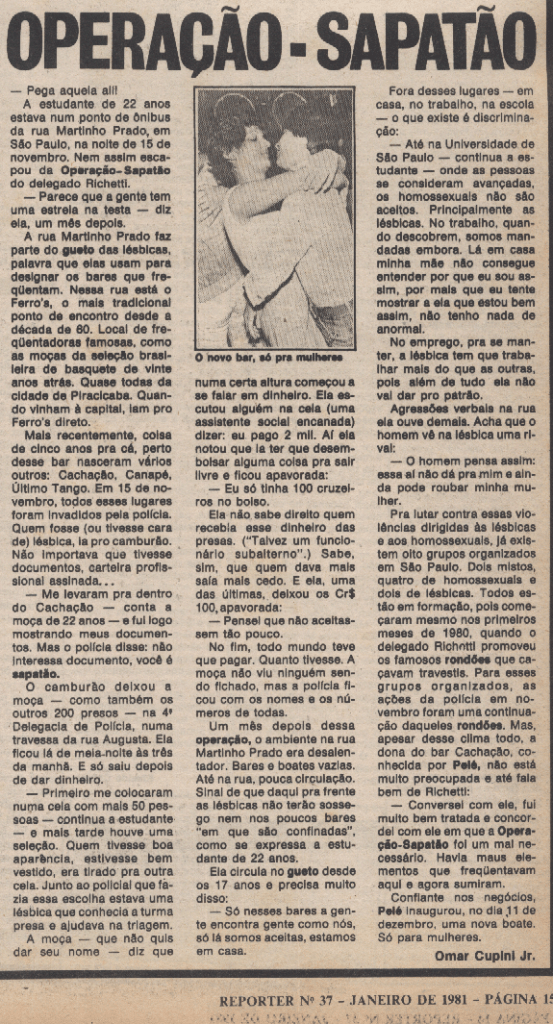
Omar Cupini Jr., ‘Operação-Sapatão’, Reporter 37 (Jan 1981, Brazil), 15.
Sapatão was cemented in the historical record as a word intended to oppress the lesbian community in 1980. On 15 November of that year, a targeted police operation took place in São Paulo, known as Operação sapatão. The police force had already been targeting the Brazilian LGBTQ community, but Operação sapatão was an attack on specifically lesbian spaces.12 One street, Rua Martinho Prado, was home to a number of lesbian bars (or bars popular among lesbians), and was the site of the operation – anyone thought to be a lesbian was arrested, and weren’t allowed to leave police custody until they had paid “as much as you had”.13 This period of queer and lesbian oppression was not quietly accepted; in the early ‘80s, LGBTQ activists and lesbian feminists had begun organising en masse. They were fighting back. In July 1983, after the lesbian group GALF (Grupo de Ação Lésbica Feminista, ‘Group for Lesbian Feminist Action’) was prohibited from selling their lesbian newspaper ChanacomChana outside Ferro’s bar (the most popular of those on Rua Martinho Prado), they staged a protest in response.14 This political action, taking place on 19 August 1983, marks what is now officially recognised as the National Day of Lesbian Pride in Brazil, and often cited as a “Brazilian Stonewall”.15
I include this history here because it is the heritage of so many variations of lesbian style in Brazil today – although, since both Operação sapatão and the 1983 political action happened in São Paulo in the South of Brazil, their influence may not stretch country-wide. Many of the people I spoke to about lesbian fashion in Brazil noted that there are differences in dress depending on location, particularly in terms on fashionable hairstyles for lesbians (“in the South, a lot of the more masc lesbians have long hair” Gessica told me, while “in the North, where I am from, butches use shorter hair”).16 The preference for longer hair combined with the legacy of the term sapatão in Southern Brazil seems to culminate in a particular modern lesbian archetype: ‘Wesley Sapatão’.
Wesley Sapatão (or ‘Wesley Sapadrão’) describes a particular kind of lesbian aesthetic. It always includes long hair – the name comes from a famous Brazilian singer, Wesley Safadão, who used to wear his hair long in the same style.17 Tweets and TikTok videos joke about the look and the ‘Wesley Sapatão’ nickname, but it has a very real basis. One photo in particular is frequently circulated to illustrate the style, which I’ve included below (though with the faces cropped out, since I’m not sure who the people pictured are and whether they would appreciate being shared so widely!). The style is not limited to its nickname, however, and might also be described as a “sports lesbian” look; one of the people who responded to my questions (who would prefer to stay anonymous) described this style, among a handful of other main archetypes of lesbian fashion in modern-day Brazil:
- boyish 2000s [“sort of boy-ish, lots of piercings, undercut hairstyle, big sneakers”]
- humanities/hippie lesbian
- office lesbian (lots of plaid button-ups, for some reason – and it’s a VERY lesbian thing in Brazil)
- sports lesbian (lots of street wear, heavily inspired by boyish 2000s but more modern).18
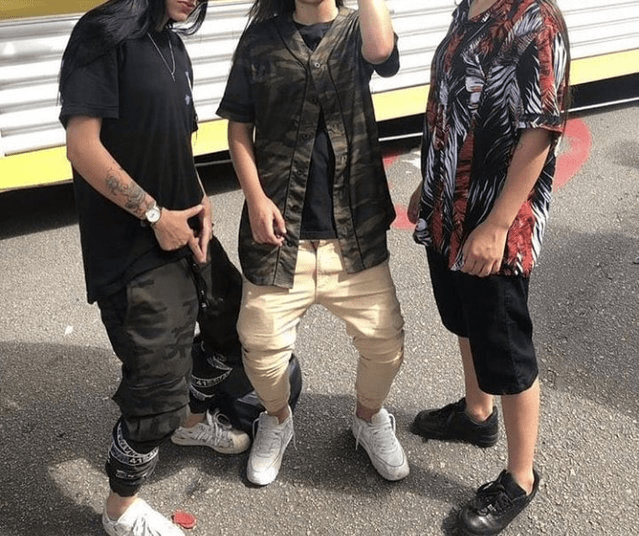
The most commonly circulated example of the ‘Wesley Sapatão’ aesthetic.
These definitions don’t describe every single possible lesbian fashion or style in the country, but encapsulate the most prominent archetypes – the styles that are most likely to be seen and recognised as being lesbian. The “office lesbian” claims the staple of the plaid shirt, but other people who I talked to mentioned other kinds of shirts, too, or described them in different ways: “button up shirts (usually colourful and patterned)” or “button-up shirts” listed alongside “casio watches, septum piercing[s] and the side shaved hairstyle”.19 The “humanities/hippie lesbian” label, too, could define a number of different people and fashions, and yet a couple of symbols reappear throughout my research. One of them, interestingly, is the coconut ring – Bia explained to me how “in Brazil there’s a very strong stereotype of lesbians who make crafts and live from nature, and the aesthetic of the ring are very much part of it.”20 In these instances, the coconut ring might be worn combined with what Clara calls “hippie-kinds of bracelets, usually sold around beaches and fairs”.21 These are all items and styles that make up a much larger whole, stitches in a rich tapestry of Brazilian lesbian fashion and visual communication. Lesbian fashion has never been a rule book, after all, but a way to express ourselves and understand one another.
With this article, I am not trying to define Brazilian lesbian fashion as any one thing, or even a selection of things. I hope, however, that it is a celebration. I hope that, by gathering so many different thoughts and experiences together, some of Brazil’s lesbian fashion culture might be appreciated – outside as well as within the country’s borders. I hope that, in particular, the specific legacy of lesbian fashions and signals might be recognised; while some lesbian styles overlap across nations, others are very much home-grown. The coconut ring, for instance, is not only steeped in lesbian culture and history but so many other aspects of Brazilian culture, and its place within a sprawling history of lesbian fashion does not negate its place in other histories of marginalised communities. Each of us contains multitudes, influenced by our own cultural histories, families, friends, communities, loves and desires. The clothes that we wear and the reasons that we wear them are just as expansive.
Thank you for reading this post on Dressing Dykes! If you enjoyed, feel free to follow me on Instagram or TikTok, or check out my book, Unsuitable: A History of Lesbian Fashion
Endnotes
1: Although I previously asked if those I talked to would like to remain anonymous, please let me know if you change your mind and would like me to remove any personal references (or if you would like to be credited more explicitly, such as with a link to your social media profile).
2: Clara, @claralbbh, personal interview, Instagram direct message, 26 May 2023; Giula, @giula_listo, personal interview, Instagram direct message, 27 May 2023; David Chronic, ‘The Story of the Tucum Ring’, 16 May 2012, fragments and reflections, https://davidchronic.com/2012/05/16/the-story-of-the-tucum-ring/; Chris Heuertz, ‘The Tucum Ring of Brazil: A Sign & Symbol of Solidarity + Reconciliation’, [n.d.] https://chrisheuertz.com/the-tucum-ring-of-brazil-a-sign-symbol-of-solidarity-reconciliation/.
3: Gessica, @_inncesticide, personal interview, Instagram direct message, 27 May 2023.
4: Natasha, @saab_natasha, personal interview, Instagram direct message, 27 May 2023.
5: Christine, @alligatortearsquin, personal interview, Instagram direct message, 27 May 2023.
6: Bia, @cfbia, personal interview, Instagram direct message, 27 May 2023.
7: Erica, @voigterica, personal interview, Instagram direct message, 27 May 2023.
8: @jujvgs, personal interview, Instagram direct message, 27 May 2023.
9: Giula, @giula_listo, personal interview, Instagram direct message, 27 May 2023.
10: Flávia Belmont and Amanda Álvares Ferreria, ‘Global South Perspectives on Stonewall after 50 years, Part II – Brazilian Stonewalls: Radical Politics and Lesbian Activism’, Contexto Internacional 42.3 (2020): 697.
11: Rafaela, @rafs.spalding, personal interview, Instagram direct message, 27 May 2023.
12: Luana Farias Oliveria, ‘Quem tem medo sapatão? Resistência lésbica à Ditadura Miltar (1964-1985)’, Periodicus 7.1 (2017): 16.
13: Omar Cupini Jr., Reporter 37 (Jan 1981), 15. Qted in LGBTQ+ Spacey, ‘Operação Sapatão’, 15 Nov 2021, https://lgbtqspacey.com/operacao-sapatao/
14: Oliveria, ‘Quem tem medo sapatão?’, 12-14.
15: Belmont and Ferreira, ‘Global Perspectives on Stonewall after 50 years’’, 696.
16: Gessica, @_inncesticide, personal interview, Instagram direct message, 27 May 2023.
17: Christine, @alligatortearsquin, personal interview, Instagram direct message, 27 May 2023.
18: Anonymous, personal interview, Instagram direct message, 27 May 2023.
19: Clara, @claralbbh, personal interview, Instagram direct message, 26 May 2023; Gabi, @plmtrx, personal interview, Instagram direct message, 28 May 2023.
20: Bia, @cfbia, personal interview, Instagram direct message, 27 May 2023.
21: Clara, @claralbbh, personal interview, Instagram direct message, 26 May 2023.
 Dressing Dykes